HOW YOUR TECH IMPACTS YOUR BODY and POSTURAL WORK HABITS
Have you experienced fatigue, soreness or stiffness in your neck, shoulder or arms while using your computer or phone? Have you found yourself frequently massaging or stretching your neck, back or arms? You may have the initial signs of a repetitive stress injury (RSI). Poor postural work habits contribute significantly to RSI. When Tech causes us to position ourselves in awkward positions over time, our bodies can begin to talk back to us.
RSI in tech users creates a repeating cycle of pain and injury that can affect the body’s entire upper quarter. If you catch it early, your rehab may consist simply of strengthening, stretching and some posture habit changes. It is important to address RSI before it results in permanent tissue damage and involvement of the nerves.
REPETITIVE STRESS FROM TECH USE
The following are categories of musculoskeletal disorders that can be caused by repetitive stress: lumbar(back) or cervical(neck) strain, shoulder/elbow/forearm tendonitis, carpal tunnel syndrome and eye strain. Sitting or using a device in a prolonged and sometimes sustained awkward posture, excessive repetition of tasks such as keyboarding especially if done with excessive force or speed, poor workstation design, stress and unhealthy lifestyle habits can all contribute to the potential for injury.
COMPUTER WORKSTATION TIPS for better POSTURAL WORK HABITS
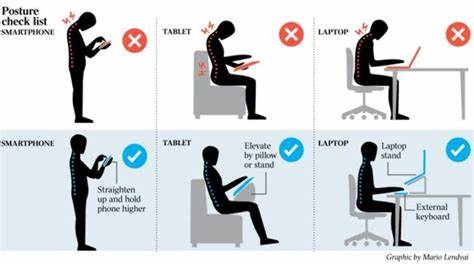
Chair positioning: Width should have one inch on both sides of the seat cushion. Depth should have room for 2-4 fingers between back of knee and edge of chair. Use the backrest. Add a lumbar roll pillow or make one using a large rolled up towel to reinforce the normal curvature in your low back region. Feet should be flat with hips/knees at 90 degrees of bend.
Desktop: Keep it clear of clutter. Keep frequently used items within arms reach.
Computer: Monitor should be directly in front of keyboard located an arm’s length away (18″-24″). Mouse in the same plane as keyboard. Laptop users may use a detached mouse to avoid excessive wrist/finger movement. Eyes should be positioned at top 1/3 of screen. Consider a wrist rest for wrist support.

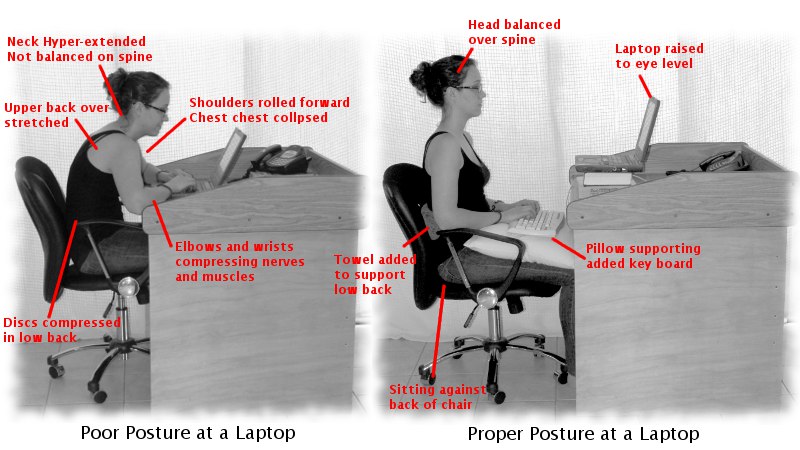
Your elbows should be at 90 degrees of bend and your forearms/wrists and hands in a straight position and parallel to the floor. Elbows should be close to your body while typing bent between 90-120 degrees. Your head should be in alignment with your torso. Avoid twisting neck or keeping it flexed too far forward. Keep your shoulders relaxed. Feet should be resting on the floor or supported with use of a footrest. A footrest can easily be made with a small stack of books.
IMPORTANCE OF TAKING PERIODIC REST BREAKS
Take a stretch break. Periodically, take a break throughout the day and stretch. Some easy stretches you can do at your desk include
1. Raise the tops of your shoulders towards your ears and hold for 5 seconds. Release. Repeat 5 times.
2. Tilt your chin towards your neck and pull head back to align earlobe with shoulder. Hold for 5 seconds Release. Repeat 5 times.
3. Turn your head towards your right shoulder. Hold 5 seconds and release. Repeat on opposite side. Repeat 5 times on each side.
4. Lean/Tilt your head bringing ear towards your right shoulder. Hold 5 seconds and release. Repeat on opposite side. Repeat 5 times on each side.
5. Get up and walk every hour. Get a drink of water. Focus on something far away rather than near.
For longer breaks: Take a walk down hallway or outside to help legs stretch. Stand with hands on hips and push the front of your pelvis forward to stretch the hip flexors muscles that are in front of your hip and have been in a shortened seated position. Pinch your shoulder blades together a few times. Take a minute to do some deep breathing and expand your ribcage. If checking your phone, do not bend your head/neck toward screen. Lift phone so that you can keep your head tall/neutral while looking at the screen.
https://www.optimal-pt.com/desk-job-exercises/
HEALTHY HABITS IN GENERAL
Adhere to healthy habits in general: Follow a healthy diet and avoid too much caffeine. Get recommended sleep. Be active outside of work with an exercise routine that encourages aerobic exertion, flexibility and strength building. A functioning body frame will be able to adapt to seated tech/work tasks easier. If you sit a great deal at work, you should avoid going home to just sit around some more.
WHEN PHYSICAL THERAPY CAN HELP
If you do need help with a suspected musculoskeletal injury, please see a physical therapist who can evaluate your posture, muscle flexibility and strength and discuss your work tasks and lifestyle. Physical therapists are trained to look at you from the big picture as well as the specific little movement areas that may be impacting you and how you feel. Physical therapy is very effective in helping to heal from repetitive strain injuries.
Please contact us at Optimal Physical Therapy and Sports Performance if you have any questions or would like to come in for an evaluation. Our phone number is 724-779-1300.